
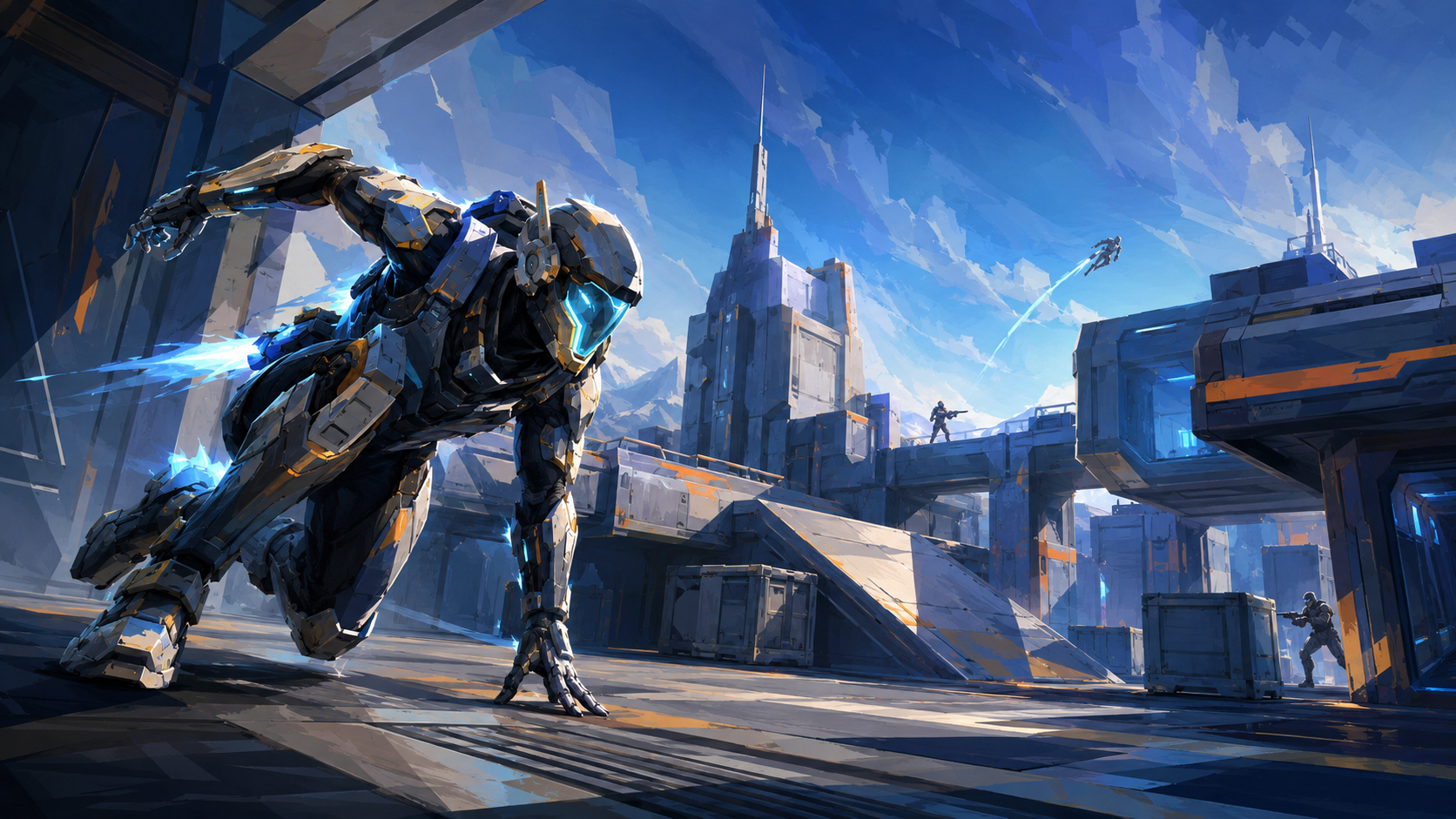
Voyager is a love letter to multiplayer FPS games and to the craft of making games. It’s being built around a simple belief: gameplay and player experience should come before storefronts, engagement metrics, streaming trends, and manufactured competition.
Voyager is a science-fiction multiplayer FPS where you play as a pilot operating a customizable mech suit. The suit gives us a foundation for advanced movement without turning the game into a traditional hero shooter. You’re not selecting a character because of their abilities. You’re building and controlling your own pilot and suit.
Why Voyager Exists
In today’s gaming climate, it can feel like we’re not choosing what to play because we’re excited about it. We’re falling back on what we know because there doesn’t seem to be anything better.
It’s comfortable and familiar, but it often leaves us unsatisfied, tired, and disappointed. Kind of like fast food. It’s quick, familiar, and satisfies an immediate craving, but it doesn’t leave you feeling fulfilled for long.
So, what ingredients are making games feel like fast food?
FOMO
It often feels like the store is being designed before the gameplay and player experience have been fully considered. In some games, the store has practically become part of the gameplay loop.
Monetization itself isn’t the problem. Developers need to make money and games need continued support. The problem is when progression, artificial rarity, countdown timers, battle passes, and premium currencies begin dictating how the game is designed.
A good game with clear direction and purpose should give people a reason to support it. Players shouldn’t need to be pressured by the fear that an item will disappear forever, especially after already paying $70 for the base game.
Movement Spam
This may sound like a skill issue. It very well might be, or maybe I’m just getting old. Either way, I’m a firm believer that I shouldn’t need an energy drink just to understand what is happening on my screen.
Movement has shifted away from traversal and positioning and toward making yourself as unpredictable and difficult to hit as possible. Players slide in every direction, repeatedly jump during engagements, drop-shot, and chain movement mechanics together whenever someone begins shooting at them.
Movement should create opportunities. It shouldn’t make every gunfight feel like you’re trying to shoot a fly that got trapped inside your house.
Games Became a Job on Top of Your Job
Games are becoming increasingly complicated, with layered progression systems, convoluted mechanics, daily challenges, limited-time rewards, and constantly changing metas.
You can spend hundreds or even thousands of hours learning a game before feeling competent enough to enjoy it consistently.
I miss being able to come home from work or school, launch the game, play with friends for a few hours, and leave satisfied. You should not feel punished for taking a week off. A game should respect your time rather than constantly compete for it.
The Movement Philosophy
I have always loved advanced movement mechanics such as sprinting, vaulting, climbing, dashing, double jumping, and flying. However, these mechanics are frequently exploited during combat rather than used for traversal and positioning.
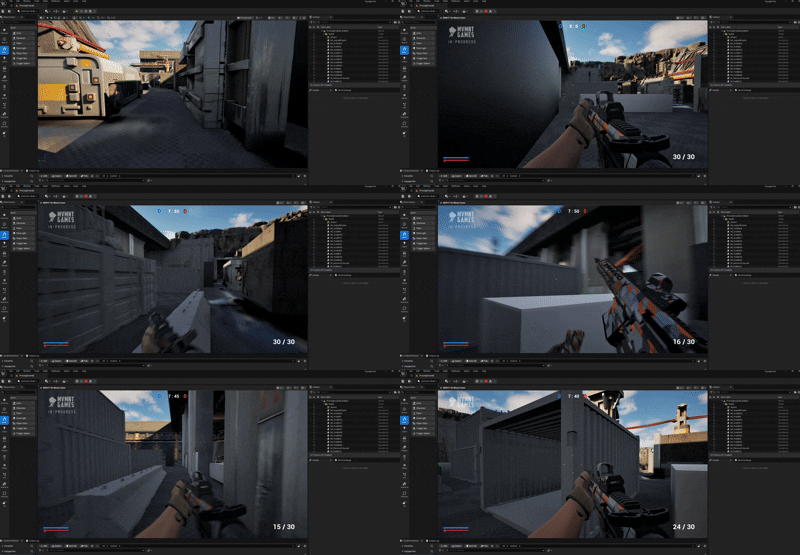
Voyager’s movement will be designed around positional advantage and commitment.
Movement can help you enter an engagement, escape a dangerous area, cross open ground, or reach an advantageous position. It should not become a panic button that allows you to instantly dodge in every direction once someone begins shooting at you.
Advanced mechanics such as dashing will generally commit the player forward. You shouldn’t need to worry that the player you’re shooting can dash left, dash right, dash backward, visit Mars, and return before you finish the engagement.
Attempting to spam movement during combat may introduce consequences such as reduced accuracy, slower weapon readiness, reduced movement effectiveness, or brief recovery periods.
Movement should be powerful, readable, and intentional. Not obnoxious.
Developed in the Open
Voyager will be developed transparently through playable snapshots, community playtests, development posts, and direct communication.
During early development, my goal is to release a new playable snapshot roughly every two weeks. These snapshots may include gameplay adjustments, experimental mechanics, new features, or revisions based directly on player feedback.
As development becomes more complicated, some snapshots may require additional time. When that happens, I will communicate it openly rather than disappearing behind a closed curtain.
The community will not simply see Voyager after years of development. You will see the rough versions, play the broken versions, challenge design decisions, and meaningfully shape what the game becomes.
What Will Voyager Become?
Voyager does not currently have a predetermined “main” game mode.
That does not mean the project lacks direction. Its principles are already established: satisfying gunplay, readable engagements, movement built around positioning, accessible mechanics, and respect for the player’s time.
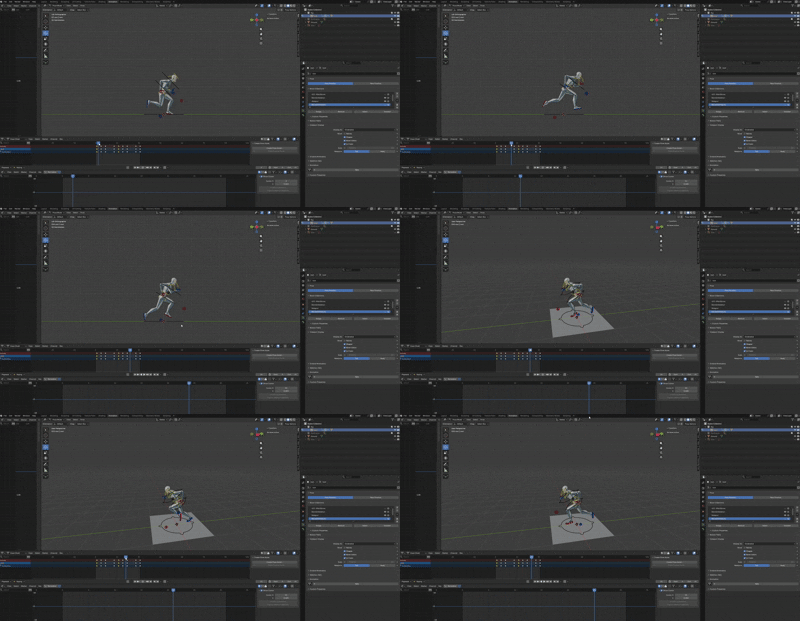
What we have not determined is which game mode best brings those principles together.
I hope that through snapshots and playtests, we can discover something new rather than automatically building another battle royale or extraction shooter simply because those modes are popular.
The long-term movement vision includes:
- Sprinting
- Assault sprinting
- Dashing
- Vaulting
- Climbing
- Double jumping
- Flying
These mechanics will be supported by the pilot and customizable mech-suit concept, but every mechanic will still need to prove that it improves the game. Nothing is included simply because it sounds impressive on paper.
What will Voyager ultimately become?
We are going to find out by playing it.
The First Step
The first step is Snapshot 00, a deliberately small and imperfect multiplayer build designed to answer one question before anything else:
Is Voyager fun to play?